How to use the Back Trac
Learn how to position yourself on the roll, where to place it along your spine, and how to move for mid- and full-back relief.
Watch on YouTube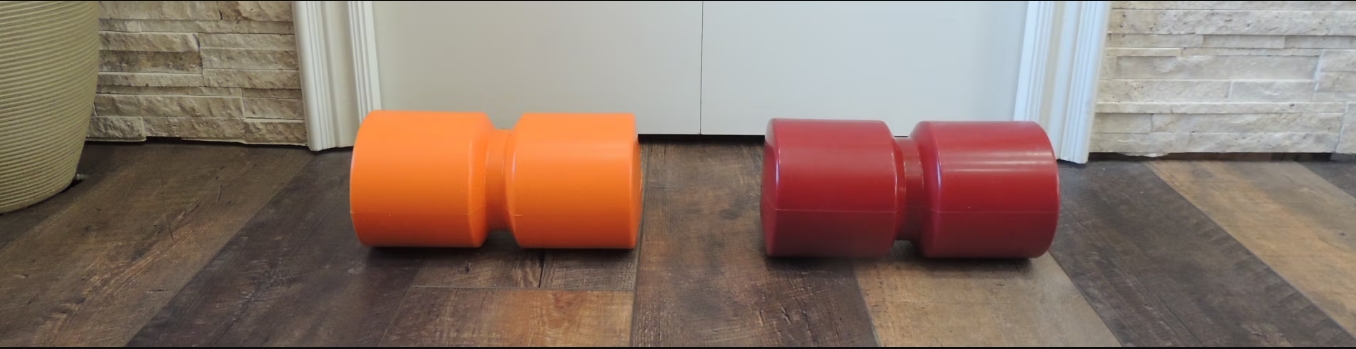
Use the Back Trac’s deep groove to let your spine “float” while muscles and ligaments relax, joints open, and the mid- and full-back move toward better alignment.
Over time, falls, sports, repetitive motions, and long hours sitting can change how vertebrae stack on one another. Adaptive posture may keep you moving, but it often leads to tight muscles, reduced range of motion, and lower endurance.
When spinal segments stay out of ideal alignment, discs and joints take more shear and wear than they should. The Back Trac gives you a way to gently address that at home by guiding each vertebra back toward a healthier position.
Rolling on the Back Trac a few times in the morning and evening can become your “daily tune-up” for posture and comfort. Many users describe it as an at-home massage for the spine that they can pack and use anywhere.
Many foam, plastic, and rubber back rollers push directly into the spine and can feel sharp or uncomfortable. The Back Trac uses a deep, patented groove so the spinous processes are protected while the outer edges contact the transverse processes.
As you lie over the roll and move your trunk, body weight encourages each joint to stretch and the vertebrae to slide into a more desirable path—something flat rollers simply don’t do as well. This is why you may hear satisfying pops and clicks as you roll and then feel taller, lighter, and straighter when you stand.
The goal is not just relief during the session, but better structure so daily forces are shared by bone rather than over-worked muscles and irritated discs.
The Back Trac is a six-inch-diameter, twelve-inch-long foam roller designed specifically for spinal work. It is large enough to hold your body weight, yet compact enough to carry in one hand.
Use it on the floor, on a mat, or wherever you have space to lie down. Many people keep one at home and one in the gym or office so they can restore their back whenever tension builds up.
Its shape and groove were created using mathematical equations from Spinal Fitness research, giving you a tool that reflects years of clinical and engineering work.
Always listen to your body and move within a comfortable range. If needed, consult your health professional before starting a new exercise or spinal-care routine.
Step 1 – Set up: Place the Back Trac on the floor. Sit in front of it, then gently lie back so it rests between your low and mid-back.
Step 2 – Roll: Cross your arms or support your head, bend your knees, and slowly roll the Back Trac up and down between the lumbar area and the shoulder blades using your legs to control the movement.
Step 3 – Breathe: Take slow breaths and allow muscles and ligaments to relax as the joints gently open. Pops and clicks are common as segments realign.
Step 4 – Stand and notice: After rolling, stand up and feel how your height, posture, and back comfort have changed.
These short clips show how the Back Trac works, why the groove design matters, and how it can change posture and comfort in just a few minutes of rolling.
Learn how to position yourself on the roll, where to place it along your spine, and how to move for mid- and full-back relief.
Watch on YouTubeInventor Eileen Durfee explains how the Back Trac groove lets the spinous float while the transverse processes ride like a train on tracks to encourage alignment.
Watch on YouTube