Continuous Output
Produces ozonated water while water flows through the machine.
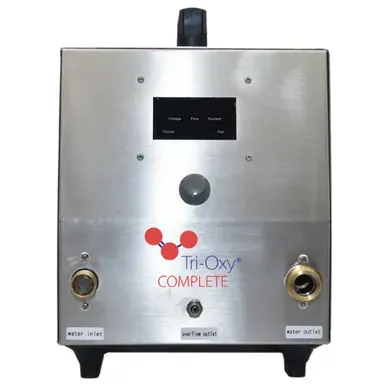
Produce fresh ozonated water continuously from tap water and air. Tri-Oxy COMPLETE is a portable, high-output ozone water generator designed for home cleaning, produce washing, gardens, greenhouses, agriculture, animal-care facilities, food-processing environments, equipment rinsing, and other compatible water-treatment applications.
Unlike a tabletop ozone generator that treats one jar at a time, COMPLETE connects directly to a water supply, automatically mixes ozone gas with flowing water, and delivers adjustable ozonated water on demand.
Small ozone generators usually send ozone gas through tubing into a jar or container. That approach is useful for small-batch water preparation. Tri-Oxy COMPLETE is designed for applications that need more water, more mobility, and continuous output.
Tap water passes through the machine, ozone gas is introduced through a micro gas-water mixing system, and freshly ozonated water exits for spraying, flushing, washing, immersing, misting, or wiping.
Produces ozonated water while water flows through the machine.
Prepare fresh ozone water when needed rather than storing treated water.
Use the control knob to adjust ozone concentration for the intended application.
Move the unit between suitable home, garden, greenhouse, barn, or work areas.
Ozone is a reactive form of oxygen made of three oxygen atoms. Water-treatment systems use ozone because it reacts rapidly with susceptible microorganisms, odors, colors, and selected organic or inorganic compounds.
Ozone is used in applications such as drinking-water treatment, wastewater treatment, food-processing rinse water, equipment sanitation, odor control, and oxidation of compounds such as iron, manganese, and selected contaminants.
Ozone reacts quickly with susceptible microorganisms and compounds.
The machine generates ozone from air rather than storing liquid sanitizer concentrate.
Ozonated water is generated when needed and should be used promptly.
Use by spraying, rinsing, flushing, wiping, misting, or immersion when appropriate.
Water temperature, pH, dissolved minerals, organic load, water flow, inlet pressure, hose configuration, and control settings can all influence the concentration and stability of ozone in the water.
Rinse compatible counters, sinks, cutting boards, tools, and food-preparation surfaces.
Use on compatible shower, sink, tile, and bathroom surfaces.
Rinse compatible bowls, crates, kennels, floors, and animal-care equipment.
Use ozonated water on compatible washable surfaces where odors accumulate.
Rinse compatible hard toys, containers, and washable household goods.
Wash compatible bins, lids, floors, and surrounding surfaces.
Use for compatible utility-sink, floor, equipment, and container cleaning.
Apply freshly prepared ozone water to compatible washable materials.
Fresh ozonated water can be used as part of produce-washing and food-handling sanitation routines when the machine is operated according to its manual and applicable food-safety procedures.
Rinse apples, berries, citrus, melons, and other suitable produce.
Wash roots, greens, cucumbers, onions, tomatoes, and other suitable vegetables.
Use as part of controlled washing routines for compatible leafy produce.
Rinse compatible bins, tubs, trays, and reusable food-handling containers.
Use on compatible knives, utensils, racks, and food-processing equipment.
Wash compatible equipment, surfaces, and reusable packaging components.
Use only within appropriate food-processing procedures and applicable regulations.
Use according to applicable egg-washing and food-safety requirements.
Growers use ozone water in selected agricultural and greenhouse routines because it can be generated on demand and applied through spraying, rinsing, misting, and equipment washing.
Rinse compatible benches, trays, tools, floors, and growing-area equipment.
Use within a carefully managed plant-care program appropriate to the crop.
Use on compatible irrigation, greenhouse, and water-handling surfaces.
Rinse compatible pots, trays, lines, tanks, and hydroponic equipment.
Wash compatible bins, baskets, tables, and reusable harvest tools.
Use only when suitable for the plant species, concentration, and growing conditions.
Use for compatible line, tank, emitter, and water-system sanitation routines.
Prepare fresh ozonated water for compatible post-harvest handling programs.
Explore ozone-water applications in plant-care routines in Effects of Ozone and Powdery Mildew.
Read the Powdery Mildew ArticleWash compatible stalls, buckets, walls, mats, tools, and barn surfaces.
Rinse compatible drinkers, equipment, floors, crates, and housing surfaces.
Use for compatible pen, feeder, floor, and equipment washing.
Wash compatible runs, crates, bowls, tools, and washable surfaces.
Rinse suitable cages, trays, containers, and handling equipment.
Clean compatible containers according to animal-care procedures.
Use ozonated water on compatible washable surfaces where organic odors accumulate.
Integrate into appropriate cleaning protocols between pens, tools, and work areas.
Use within appropriate rinse-water, equipment, and sanitation procedures.
Prepare fresh ozone water for compatible cleaning and rinsing applications.
Wash compatible conveyors, containers, tools, and processing surfaces.
Use for compatible pipelines, tanks, equipment surfaces, and rinse systems.
Use only within engineered systems appropriate to the water chemistry and process.
Use in compatible wash-down applications where odor-producing compounds accumulate.
Support suitable produce, equipment, container, and post-harvest washing routines.
Integrate into suitable barn, kennel, stable, and equipment-cleaning programs.
Produces ozonated water while the connected water supply is flowing.
Automatically combines generated ozone gas with incoming water.
Supports automatic operation in response to suitable water-flow conditions.
Updated digital interface replaces the earlier gauge-style display.
Control knob allows adjustment within the machine’s operating range.
Designed with a removable ozone-generator module for service access.
No daily chemical concentrate storage is required for ozone production.
Routine care focuses on installation, water flow, ventilation, and keeping the unit clean and dry.
Place the machine where it is protected from spray, standing water, and weather exposure.
Use a compatible 5/8-inch water hose within the recommended inlet length.
Use a suitable hose that allows the required water flow without excessive restriction.
Use only the specified grounded electrical supply and keep the cord dry and protected.
Confirm that inlet pressure and water temperature are within specification.
Allow the system to establish stable flow and ozone-water mixing.
Set the control knob for the intended application and water conditions.
Ozone breaks down over time, so freshly generated water should be used promptly.
The manual contains the machine plan, connection diagrams, operating controls, maintenance requirements, and warranty conditions.
View the Tri-Oxy COMPLETE ManualUse no more than approximately 10 feet of 5/8-inch hose on the inlet side under standard conditions.
Use no more than approximately 25 feet of 5/8-inch hose on the outlet side under standard conditions.
Longer runs may require a smaller-diameter hose or an auxiliary pump selected for the installation.
A booster pump may be required when the inlet hose exceeds 10 feet or the outlet hose exceeds 25 feet. For longer distances, the original guidance recommends a 10–15 GPM auxiliary pump with an in-line flow-control switch. Installation conditions vary, so pump sizing should match the actual pressure, elevation, hose diameter, and flow requirement.
A $50 ozone generator and a commercial ozone water treatment system are answering different questions. The COMPLETE is engineered as a system: a 5 g/hr generator married to venturi injection that dissolves roughly 90% of the gas into flowing water (up to about 6 ppm), continuous duty on a live water supply, ozone-compatible materials throughout — and because the gas goes into the water instead of over it, the off-gas problem shrinks before it starts. Where that scale earns its keep:
Every performance statement is documented — read the published Tri-Oxy COMPLETE testing, and the ozone safety guide for exposure control at commercial scale.
| Model | Tri-Oxy® COMPLETE |
| Product type | Portable continuous-flow ozone water generator |
| Voltage | 110V / 60Hz |
| Power | 80 watts |
| Ozone-generator output | 5 grams per hour |
| Ozonated-water concentration | Approximately 1–5 ppm depending on operating conditions |
| Typical digital-display target | Capable of approximately 4 ppm under suitable conditions |
| Water-flow range | 8–20 liters per minute |
| Inlet water | Tap water |
| Inlet water pressure | 0.6–1.2 kg/cm² |
| Inlet water temperature | 5–30°C |
| Recommended inlet hose | 5/8-inch hose, no longer than approximately 10 feet |
| Recommended outlet hose | 5/8-inch hose, no longer than approximately 25 feet |
| Machine dimensions | Approximately 22 × 27 × 38 cm |
| Machine weight | Approximately 5 kg |
| Control system | DC 5V internal control system |
| Display | Digital display |
| Ozone adjustment | Manual concentration-control knob |
Connect only to the specified grounded electrical supply.
Protect the machine, cord, plug, controls, and vents from water and spray.
Do not disassemble, modify, bypass, or retrofit internal components.
Disconnect power before installation, removal, inspection, or maintenance.
Do not operate with a loose, cut, overheated, bent, or damaged cord or plug.
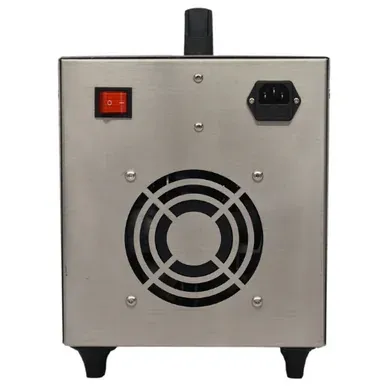
Remove dust and prevent blockage around ventilation openings.
Do not intentionally inhale ozone gas or use the machine in an enclosed unventilated area.
Confirm hose, fittings, pumps, containers, and application surfaces are compatible.
Ozone gas can irritate the respiratory system. Use the machine according to the manual, maintain ventilation, and stop operation if ozone odor accumulates near the breathing zone.
Check the inlet supply, valve position, hose kinks, pressure, and flow path.
Inspect long hose runs, elevation, inlet pressure, hose diameter, and outlet restrictions.
Check water temperature, flow rate, concentration setting, ozone module, and organic load.
Check power, plug condition, water pressure, flow-control system, and electrical supply.
Stop operation, clear the vents, allow cooling, and inspect for blocked airflow.
Stop operation, ventilate the area, and inspect hoses, fittings, mixer, and seals.
Disconnect power and consult the manual or qualified service support.
Reduce hose restriction or install a correctly sized auxiliary pump.
Compare the full Tri-Oxy ozone category, including generators, accessories, manuals, and replacement parts.
Explore the Main Ozone PageLearn about the upcoming compact 800 mg/hr ozone generator and plasma-ion air-purification system.
View Tri-Oxy REIONExplore the tabletop diffuser and degassing kit for compatible small-batch ozone-water preparation.
View Tri-OXY REFRESHView the FDA-approved 50–60 micron diffuser with stainless steel barb.
View the Diffuser StoneBrowse tubing, diffusers, jars, fittings, replacement components, and supporting equipment.
Shop Ozone AccessoriesFind setup, operating, maintenance, and safety information for Tri-Oxy systems.
View Ozone ManualsRead about ozone-water use in plant-care and powdery-mildew routines.
Read the Garden ArticleLearn about common household, produce, garden, and sanitation uses for ozonated water.
Read the Ozone Water ArticleReview the product-specific installation, machine plan, specifications, and warranty information.
View the COMPLETE ManualTri-Oxy COMPLETE combines a 5 g/hr ozone generator, automatic gas-water mixing, adjustable concentration, digital controls, and continuous-flow output in one portable system.
View the Tri-Oxy COMPLETE Manual