Sauna For Flexibility

Home/Store/Near Infrared & Red Light Saunas/Exercise Sauna/Sauna For Flexibility
Sauna Fix® • Sauna for Flexibility

Where Heat Helps, and Where Consistency Does the Work

Warming up in a near-infrared sauna makes stretching feel easier and can increase how far you move today. Lasting flexibility, though, is built by returning to end range often — the heat is a comfortable setting for that practice, not a replacement for it.

Easier end range when warm More comfortable holds Gains come from consistency Mild tension, never pain
Shop Radiant Sauna Tents See How Flexibility Is Built

Set expectations first: A single warm session mainly gives you a temporary increase in range. Real change shows up over weeks of regular practice — see acute range vs. lasting flexibility before you judge progress by one session.

What flexibility is What heat does Acute vs. lasting Build it to last Science FAQ
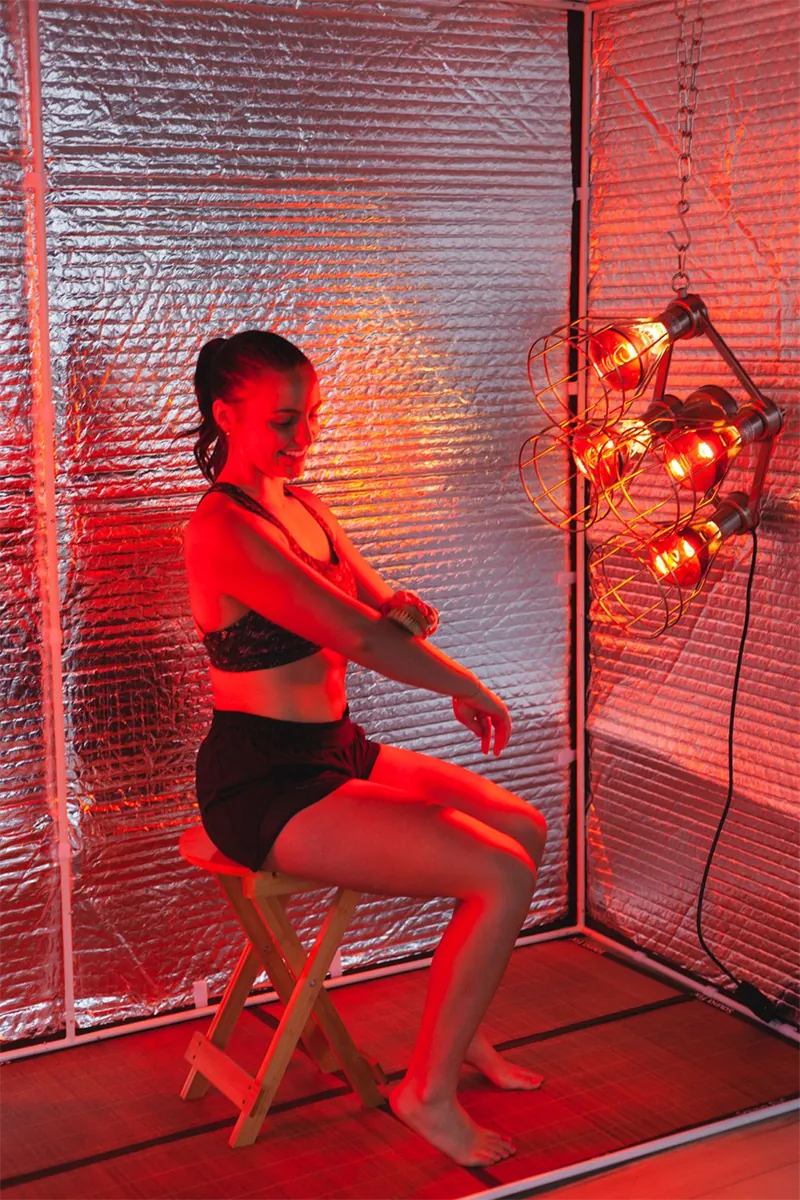
Seated arm stretch during a near infrared sauna session

Warm first, then work end range

A few minutes of near-infrared heat raises tissue temperature so you reach a comfortable end range with less guarding — then the repeated, gradual loading is what changes flexibility over time.

Warm-up~5–10 min before deep holds
Hold20–60 sec, to mild tension
FrequencyMost days beats once a week
TimelineWeeks, not one session
The goal, defined

What flexibility actually is — and how it changes

Flexibility is the range a joint can move through, and the willingness of the muscle-tendon tissue and nervous system to allow that movement. It is trainable, but it does not change the way soreness or a good sweat suggests. Two things move together when you stretch: the mechanical give of the tissue, and how much range your nervous system is comfortable permitting before it protectively resists.

Heat mainly influences the first of those, and only briefly. Consistent practice influences the second, and it lasts. Understanding that split is the difference between chasing a warm-day illusion and building flexibility you keep. If you want the active, movement-based version of this, the mobility sauna guide covers taking joints through range under control; this page is about the flexibility itself.

Tissue mechanics

What the heat does to your tissues

Connective tissue is viscoelastic: part spring, part putty. When it warms, its stiffness and internal resistance drop, so a given stretch meets less opposition and you reach a comfortable end range sooner. Warm muscle also contracts and relaxes a little faster, and the fluid inside a joint becomes less viscous as temperature rises — which is part of why a warmed body simply moves more freely.

Every one of those effects is temperature-dependent and temporary. As the tissue cools back toward baseline, the extra give fades. That is why the sauna is best understood as a way to make a session more productive and comfortable — not as something that permanently remodels tissue on its own.

What warming changes in a session

  • Lower tissue stiffness — stretches feel less abrupt
  • Reduced joint-fluid viscosity — movement feels smoother
  • Faster muscle relaxation — less guarding at end range
  • Greater comfort — you tolerate the position more easily

All temporary and reversible as the tissue cools.

The key distinction

Acute range of motion vs. lasting flexibility

The single most useful idea on this page: the range you gain right after warming and stretching is mostly acute — a short-lived increase driven by warmth and by your nervous system briefly allowing more movement. The flexibility you keep is chronic — the result of returning to end range repeatedly over weeks until that new range feels normal.

A well-supported view in the stretching literature is that much of the range you gain reflects improved stretch tolerance rather than a permanent lengthening of muscle or tendon. In plain terms, you are teaching your nervous system that a deeper position is safe, more than you are stretching tissue longer. Heat helps you get there comfortably today; consistency is what makes it stick.

Why this matters for the sauna: because heat inflates your acute range, it is easy to mistake a warm-day stretch for real progress. Judge flexibility by where you start cold on an ordinary day after several weeks of practice — not by how far you fold at the end of a hot session.
Make it last

How to build flexibility that lasts

  • Warm before you stretch deep. A short near-infrared warm-up raises tissue temperature so you can reach end range with less guarding. Save the deepest holds for after you feel warm.
  • Favor frequency over duration. A few minutes most days changes flexibility more reliably than one long weekly session.
  • Hold to mild tension, not pain. Static holds of roughly 20–60 seconds are plenty. Pain triggers protective resistance, which works against you.
  • Progress the range gradually. Add a little depth only once the current range feels easy. Chasing depth is how people overreach in the heat.
  • Give it weeks. Durable change accrues over weeks of consistent exposure to end range — not in a single session, however warm.

If you prefer holding positions, the sauna stretching guide covers deeper static holds in detail. If you would rather earn range through movement, see the mobility sauna guide. And if you want a full heated practice that blends both, hot yoga in the sauna is a natural fit.

Heat changes how a stretch feels — don’t overreach

Warmth dulls the stretch sensation and temporarily increases how far you can move. That combination makes it easy to push past a safe range without the usual warning feeling. Stretch to mild tension only, ease out of any position that produces sharp or radiating discomfort, and remember that a deeper fold at 150°F is not proof of progress.

Leave the heat and cool down if you feel dizzy, nauseated, or lightheaded. If you are pregnant, have a cardiovascular or heat-related condition, or a joint injury, get medical clearance before combining heat with end-range stretching.

Evidence

What the research says about heat and flexibility

The findings below come from controlled human research and a systematic review. Where a study qualifies the effect, that qualification is kept in view.

Direct sauna evidence

Sauna-based yoga improved sit-and-reach flexibility far more than the same routine unheated

In a randomized trial, healthy older adults who performed the same 30-minute yoga-and-mobility program in a ~122°F sauna once a week for eight weeks improved chair sit-and-reach flexibility markedly more than a group doing it at room temperature. Shoulder and lateral-spine measures did not differ significantly, so the clearest gain was in the hamstrings and posterior chain.

Read the RCT (Ketelhut & Ketelhut, 2019)
Heat as an adjunct

A systematic review found heat increases range of motion and can make stretching more effective

Across 36 human studies and 1,301 participants, heat was associated with greater joint range of motion, and combining heat with stretching was generally more effective than stretching alone. Effects on passive stiffness were less consistent, and the underlying trials carried a relatively high risk of bias.

Read the systematic review (Bleakley & Costello, 2013)
Why range improves

Range-of-motion gains reflect stiffness and stretch tolerance, not longer muscle

A 2025 meta-analysis of 65 studies found static stretching produced small reductions in stiffness and a moderate increase in tolerable passive torque, with no significant change in muscle fascicle length — evidence that added range comes from mechanical and sensory adaptation rather than permanent lengthening of the tissue.

Read the meta-analysis (Ingram et al., 2025)
Honest limits

Heat's acute advantage can be modest and joint-specific

When experienced practitioners performed the same yoga session heated versus at room temperature, only hip abduction improved significantly out of thirteen range-of-motion measures. That supports careful wording: not every joint becomes substantially more flexible after a single heated session.

Read the study (Tracy et al., 2020)
Timing

Warm tissue cools quickly — stretch during or right after the heat

Deep-heating research shows tissue temperature falls rapidly once heating stops, leaving only a short window while the tissue is warmest. The practical implication is to do flexibility work during the sauna session rather than long after leaving it. (That study used ultrasound heating, which differs from a sauna, so the exact window does not transfer directly.)

Read the study (Draper & Ricard, 1995)

How to read this evidence: the strongest direct finding is that stretching or yoga in a moderately heated sauna improved flexibility more than the same work unheated in older adults, and a systematic review supports heat as an effective adjunct to stretching for range of motion. Those gains reflect warmer, less stiff tissue plus greater stretch tolerance — not permanent lengthening — and heat’s acute advantage can be modest and joint-specific. Use the sauna to make consistent practice more comfortable and effective, and let consistency do the lasting work.

FAQ

My experience

I used to chase flexibility in the heat and wonder why Monday’s gains were gone by Thursday. What changed my results was exactly what this page teaches: treating the warm session as the opportunity and consistency as the method. Short stretching in nearly every sauna session, easy depth, months on end — that is how my forward fold finally stopped being a negotiation. The heat opens the door; showing up daily is what walks through it.

Sauna and flexibility questions

Will a sauna make me more flexible?

Heat can make a stretch feel easier and can increase how far you move in that session, but lasting flexibility comes from stretching consistently over weeks — not from heat alone. Think of the sauna as a comfortable environment for the work, not a shortcut past it.

Does heat actually lengthen my muscles?

No. Most of the range you gain after stretching reflects improved stretch tolerance — your nervous system permitting more movement — rather than a permanent lengthening of muscle or tendon. Heat temporarily lowers tissue stiffness, which is why a warm body moves more freely than a cold one.

How often should I stretch to get more flexible?

Frequency matters more than session length. Brief, near-daily practice that takes a joint to a comfortable end range generally produces more durable change than an occasional long session. Progress the range gradually rather than forcing it.

Is it better to stretch when I'm warm?

Warm tissue is more extensible and stretching warm tends to feel more comfortable, which can help you reach end range with less guarding. Whether warming produces greater long-term gains than the same stretching done cold is not firmly established — the clearest benefit is comfort and acute range.

Can I overstretch in the heat?

Yes. Because heat dulls the stretch sensation and temporarily increases range, it is easy to push past a safe position. Stretch to mild tension, never pain, and don't chase a deeper position simply because the heat makes it feel available.

Shop Radiant Sauna Tents See All Sauna Fix® Saunas

Educational notice: This page provides general educational information and is not medical advice. Combining heat with end-range stretching can increase the risk of overstretching and heat stress. Consult a qualified healthcare professional before beginning, particularly if you are pregnant or have a cardiovascular, heat-related, or joint condition.

Explore More Ways to Move

Other guides in this series

Exercise Sauna

Read the guide

Sauna Stretching

Read the guide

Mobility Sauna

Read the guide

Hot Yoga Sauna

Read the guide

Infrared Sauna Exercises

Read the guide

My experience

The honest thing I can tell you about flexibility is that the sauna makes the work pleasant enough to repeat — and repetition is the whole game. A stretch held in radiant heat feels easier the day I do it; the range that lasts came from doing it most days for years. That consistency, not any single hot session, is what changed how I move. The research on whether heat-assisted gains persist is covered honestly above, and the routine itself lives on the sauna stretching page.

By Eileen Durfee, inventor of the patented Sauna Fix® Portable Radiant Exercise and Sauna Tent, NASM Certified Personal Trainer, and daily sauna user since 2013.

Educational notice: This article is for general education. Sauna Fix® products are not intended to diagnose, treat, cure, or prevent any disease or medical condition. Individual experiences vary. Consult a qualified healthcare professional before beginning sauna use or a new exercise routine, especially if you are pregnant, take medications, or have a condition affected by heat.
  • Search Products
  • My Account
  • Track Orders
  • Shopping Bag
Powered by Lightspeed
Display prices in:USD
Skip to main content
Creatrix Solutions
Saunas
Exercise
Air Purifiers
Skin Care
Salt
Ozone
Enema Kits
Contact
About
Other
Location
Menu

creatrixsolutions

Terms of UsePrivacy PolicyShipping & Payment InfoReturn PolicyReport Abuse
Powered by Lightspeed