Sauna Stretching

Home/Store/Near Infrared & Red Light Saunas/Exercise Sauna/Sauna Stretching
Sauna Fix® • Sauna Stretching

Deeper Holds in Near-Infrared Heat

Stretching is the single most common way people move inside an exercise sauna — and for good reason. Warmth may make stretching feel more comfortable for many people, and the Sauna Fix® tent gives you the room to actually get into position.

Long, held stretches Warm tissue, less resistance Room to fully extend Near-infrared radiant heat
Shop the Exercise Sauna See a Sample Routine

Part of a bigger system: This page covers stretching specifically. For the full setup, activity options, and product comparison, see the Exercise Sauna overview.

Why stretch in heat Sample routine Fascial slings & lymph flow What you need Science FAQ
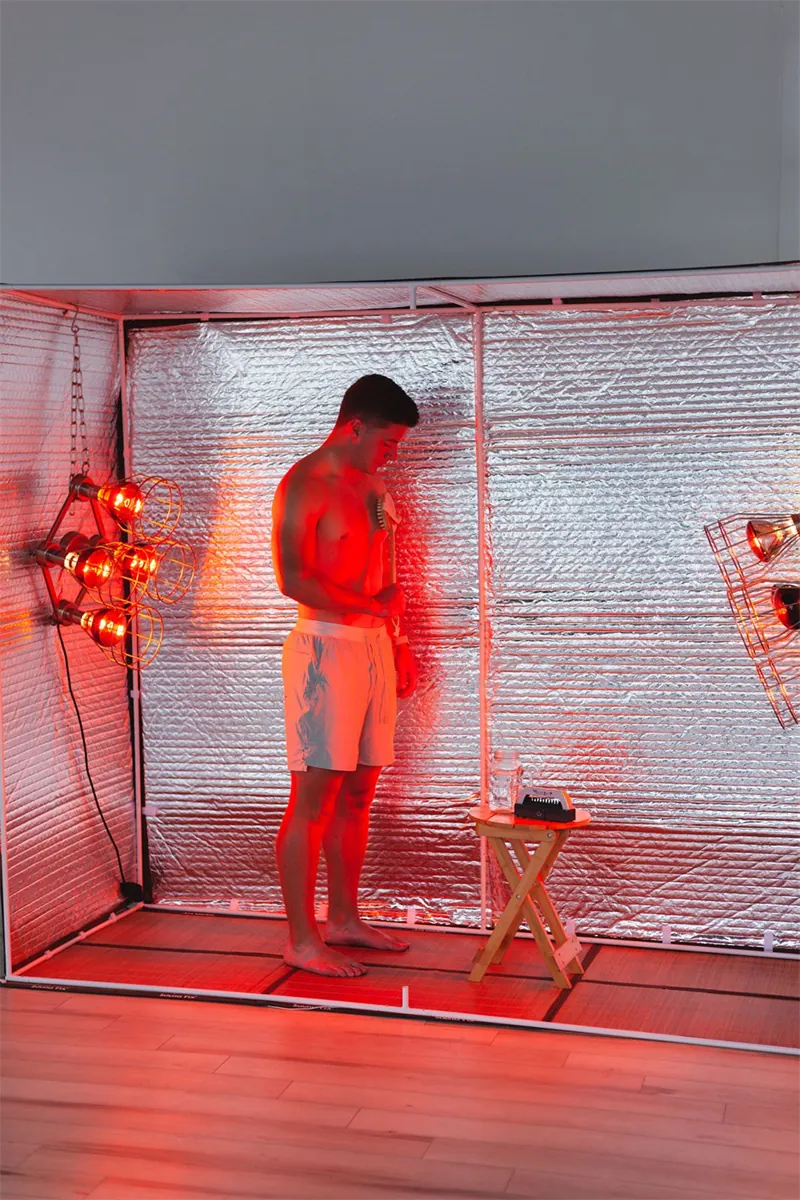
Standing stretch beside the Sauna Fix near infrared lamp

Built for held positions, not just sitting

The long tent format gives you room to fully extend into a hamstring, hip, or shoulder stretch without touching a heated surface.

Best forStatic holds, 20–60 seconds
Session length10–20 minutes to start
Why stretch in heat

Warm tissue moves differently than cold tissue

Heating tissue before a prolonged stretch has been shown in clinical research to produce greater range-of-motion gains than stretching alone — though the effect isn't automatic, and not every study on heat-plus-stretching finds an added benefit over stretching by itself. What the research more consistently shows is that flexibility gains, whether from heat or from a stretching program alone, often come down to how much stretch sensation a person can comfortably tolerate, not a permanent change in tissue length. In practice, that means the sauna's role is making a stretching session easier to sustain and more comfortable to hold — not a mechanism that lengthens fascia on its own.

This is also why space matters more here than in a compact cabin. A hamstring stretch, a doorway-style shoulder opener, or a seated spinal twist all need room to fully extend a limb — something a small sit-down sauna simply isn't built for.

What sauna stretching is good for

  • Long, static holds rather than fast, bouncing movement
  • Areas that feel chronically tight — hips, hamstrings, shoulders, upper back
  • A calm, unhurried session paired with slow breathing
  • Pairing with a structured mobility or corrective program

What it's not

  • Not a substitute for a proper warm-up before intense exercise
  • Not a way to force a stretch past a comfortable range
  • Not a treatment for an existing injury without medical guidance
  • Not a high-intensity workout — pacing stays slow throughout
A Simple Starting Point

A 15-minute sauna stretching routine

Move slowly between each position. Nothing here should ever feel like straining or pushing through pain.

1

Settle in (2 min)

Sit or kneel comfortably and let your breathing slow before starting any stretch.

2

Neck and shoulders (3 min)

Slow neck tilts and shoulder rolls, followed by a gentle cross-body shoulder stretch on each side.

3

Upper back and spine (3 min)

Seated spinal twists and a cat-cow style movement, held briefly at each end range.

4

Hips and hamstrings (5 min)

Seated forward fold, figure-four hip stretch, and a gentle hamstring stretch against the tent floor.

5

Cool down (2 min)

Return to a comfortable seated position and let your breathing and heart rate settle before exiting.

6

Rehydrate

Drink water after your session, especially if you noticed meaningful sweating.

Looking for something more structured? The Spinal Fitness program's phase-based approach can be practiced inside the sauna once you're familiar with the movements outside of it.

Beyond the Basic Stretch

Fascial Sling Work and Lymphatic Flow

Most stretching routines move one joint at a time. The body doesn't actually work that way — force and movement travel through the body along diagonal chains of muscle and connective tissue called fascial slings. Warmth from the sauna can make these longer, cross-body patterns feel more accessible to move through.

The four major slings

  • Posterior Oblique Sling: connects one side's latissimus dorsi through the thoracolumbar fascia to the opposite glute — active in walking, throwing, and rotational reach. (2024 study)
  • Anterior Oblique Sling: connects the obliques across the front of the pelvis to the opposite inner thigh — active in rotating and crossing the midline.
  • Deep Longitudinal Sling: runs from the foot up through the hamstring, sacrotuberous ligament, and erector spinae — active in standing, walking, and load transfer up the spine.
  • Lateral Sling: runs from the outer hip through the glute medius and opposite adductors — active in single-leg standing and side-to-side stability.

Rather than stretching a single muscle in isolation, sling-based movement asks you to reach, rotate, or step in a diagonal pattern — which is closer to how the body actually moves in daily life and athletic activity.

Simple sling-pattern movements

  • Standing contralateral reach: step one foot forward and reach the opposite arm overhead and across — engages the posterior oblique sling.
  • Standing diagonal chop: rotate the torso to bring both hands from high on one side down to the opposite hip — engages the anterior oblique sling.
  • Standing side reach: feet together, reach one arm overhead and lean gently to the opposite side — engages the lateral sling.
  • Forward hinge with a long spine: hinge at the hips with a flat back rather than rounding — engages the deep longitudinal sling from foot to spine.

Why movement matters for lymphatic flow

Unlike the cardiovascular system, the lymphatic system has no central pump. Lymph fluid moves primarily through three mechanisms: skeletal muscle contraction around lymph vessels, the pressure changes created by diaphragmatic breathing, and the rhythmic contraction of the lymph vessels themselves. Gravity and joint movement also play a role in helping fluid move toward the lymph nodes for filtering.

This is part of why gentle, rhythmic, whole-body movement — rather than staying still — is generally considered supportive of lymphatic circulation, and why a warm environment that makes movement more comfortable can make this easier to sustain for a full session.

Movement patterns that support lymphatic flow

  • Ankle pumps and calf raises: the calf muscles help move lymph and venous blood back up the legs.
  • Diaphragmatic breathing: slow belly breathing changes pressure in the chest and abdomen, which assists central lymph flow.
  • Gentle full-body rocking or marching in place: rhythmic, low-intensity movement rather than a static hold.
  • Arm circles and shoulder rolls: supports lymph flow through the axillary nodes under the arms.

Keep it gentle: Sling and lymph-focused movement should stay slow and low-effort — this is about circulation and range of motion, not resistance training. For a deeper, joint-by-joint approach to mobility, see the Mobility Sauna guide. A quick round of dry brushing before your session is a common complementary step for circulation.

What You Need

A few things make stretching in heat easier

Sauna Mats

Stable, non-slip flooring for seated and floor-based stretches.

Shop Mats

Sauna Wear

Loose, breathable clothing that doesn't restrict a deep stretch.

Shop Sauna Wear

NIR Safety Glasses

Worth using for longer sessions with more direct lamp exposure.

Shop Eyewear

Foam Rollers

Use just before or after your sauna session to prep or release tissue.

Shop Foam Rollers
Browse All Sauna Accessories
What the science shows

Research on heat, stretching, and lymphatic flow

Research on heat and flexibility is strongest for local, deep tissue heating combined with prolonged stretching — not necessarily for whole-body sauna heat by itself. The studies below are presented with that distinction intact, rather than treated as uniform proof that sauna heat increases flexibility.

How to read this evidence

Most applicable Studies on deep heating combined with prolonged stretching, and on the physiology of muscle contraction and breathing driving lymph flow.
Related but not identical Sauna-specific research on joint mobility, most of which comes from rheumatic-disease populations rather than healthy adults.
Not established That whole-body sauna heat, by itself, directly increases flexibility or pumps lymph — movement and breathing are the mechanisms the evidence actually supports.
Heat + stretching

Deep heating before a prolonged stretch increased ankle range of motion

In a controlled trial, deep tissue heating (pulsed shortwave diathermy) followed by prolonged stretching produced greater ankle dorsiflexion gains after 14 treatment days than identical stretching without the heating.

This used therapeutic deep heating equipment, not a sauna — the result supports heat-plus-stretching as a concept, not sauna specifically.

Read the PubMed study
Mixed evidence

Heating doesn't always add a benefit over stretching alone

A comparable study on hamstring flexibility found that short-duration stretching combined with deep heating was not more effective than stretching alone — both groups improved similarly.

The takeaway: heat is not a guaranteed multiplier on every stretching protocol, and duration and technique matter as much as temperature.

Read the PubMed study
Infrared specific

Infrared showed the largest effect among compared heating methods for hamstring flexibility

A 2023 comparison of hot packs, infrared, and ultrasound found all three associated with increased hamstring flexibility, with infrared showing the largest effect size — though adding any heat before stretching didn't clearly outperform stretching alone.

Supportive of infrared specifically, but not conclusive proof that infrared sauna sessions replicate this clinical protocol.

Read the study
Sauna review

Sauna bathing is associated with reduced pain and improved joint mobility in rheumatic disease

A clinical review notes sauna bathing may alleviate pain and improve joint mobility in people with rheumatic conditions. This does not establish that sauna acutely increases range of motion in healthy adults without a joint condition.

Read the PubMed review
Flexibility mechanism

Flexibility gains often reflect stretch tolerance, not permanent tissue lengthening

Classic research on hamstring stretching found that participants tolerated greater stretch loads after training, while the passive mechanical properties of the muscle changed little — suggesting much of a "flexibility gain" is increased tolerance of the stretch sensation itself.

Read the PubMed study
Myofascial force transmission

Latissimus dorsi contraction measurably changes the opposite hip — direct evidence for the posterior oblique sling

A 2024 study found that latissimus dorsi contraction increased lumbar stiffness and altered the resting position, passive torque, and stiffness of the contralateral gluteus maximus in runners — human evidence of mechanical interaction across the thoracolumbar fascia between shoulder/trunk and opposite hip.

Read the PubMed study
Lymph flow

Dynamic muscle contraction markedly accelerates lymph transport

Using radiolabeled tracer and imaging in human thigh muscle, researchers found dynamic exercise significantly accelerated lymphatic clearance, while sustained isometric (static) contraction could temporarily slow flow during the contraction itself.

This is the direct evidence behind recommending rhythmic movement — ankle pumps, gentle marching, arm circles — over staying still.

Read the PubMed study
Breathing + lymph

Breathing and body position measurably affect thoracic duct flow

Ultrasound imaging showed that respiration and body position affect thoracic duct dimensions and flow at the point where lymph returns to the venous circulation — direct support for diaphragmatic breathing's role in lymph return.

Read the PubMed study

Practical takeaway: The clearest, best-supported claim on this page is that movement and diaphragmatic breathing — not heat by itself — are what the evidence links to lymphatic flow. For flexibility, heat-plus-stretching shows real promise in clinical research, but whole-body sauna heat specifically increasing range of motion in healthy adults remains an area with limited direct evidence. The sauna's most defensible role here is making a stretching or mobility session more comfortable to sustain, not a standalone mechanism for lengthening tissue or pumping lymph.

FAQ

My experience

Stretching in radiant heat is how most of my own sessions begin. I spent years in nuclear power plants and then years hunched over patent drawings, and my hamstrings and hips kept the receipts. The routine on this page is the one I actually run — slow holds, warm tissue, no forcing — and it is the difference between stretching that feels like a chore and stretching my body asks for. The tent made the habit stick because the warmth makes the first two minutes pleasant instead of stiff.

Sauna stretching questions

Does stretching in a sauna actually improve flexibility?

Research on heat-plus-stretching is genuinely promising — deep tissue heating before a prolonged stretch has been shown to improve range of motion more than stretching alone — but that evidence comes mostly from clinical heating equipment, not sauna specifically, and not every study finds an added benefit. What's well established is that flexibility gains often reflect how well you tolerate the stretch sensation, not a permanent lengthening of tissue, so sauna stretching is best thought of as a comfortable, sustainable complement to a regular mobility routine — not a shortcut past it.

How long should I hold each stretch?

Static holds of 20–60 seconds are typical. There's no need to push into pain — a stretch should feel like tension easing, not straining.

Can I stretch every day in the sauna?

Many people do, especially for chronically tight areas like hips and shoulders. Listen to your body and reduce frequency or intensity if you notice soreness that doesn't resolve.

What are fascial slings and why do they matter for stretching?

Fascial slings are diagonal chains of muscle and connective tissue that transfer force across the body — for example, from one shoulder through the trunk to the opposite hip. Moving through these patterns with a reach, rotation, or step, rather than stretching one muscle at a time, more closely mirrors how the body actually moves.

Can sauna sessions help with lymphatic flow?

The lymphatic system relies on muscle contraction, breathing, and joint movement to circulate fluid, since it has no central pump of its own. Gentle, rhythmic movement — ankle pumps, arm circles, slow breathing — supports that circulation. The heat itself doesn't move lymph; the movement does.

What's the difference between this page and the Exercise Sauna page?

The Exercise Sauna page covers the full system — products, configurations, and every type of movement. This page focuses specifically on stretching routines and technique.

Shop the Exercise Sauna See the Full Exercise Sauna Guide

Educational and safety notice: This page provides general educational information and is not medical advice. Stop stretching and consult a qualified healthcare professional if you experience sharp pain, numbness, or symptoms beyond normal muscle tension.

Explore More Ways to Move

Other guides in this series

Exercise Sauna

Read the guide

Mobility Sauna

Read the guide

Hot Yoga Sauna

Read the guide

Sauna for Flexibility

Read the guide

Infrared Sauna Exercises

Read the guide
What the research shows

Heat plus stretching in the published literature

The strongest publication on this topic is a systematic review by Nakano and colleagues (2012) covering 12 studies and 352 participants. Heat sources included hot packs, ultrasound, and diathermy — and combining heat with stretching produced greater range-of-motion improvements than heat alone, with repeated heat-plus-stretch sessions showing advantages over stretching alone. Read the review.

The physiology makes sense: warmer tissue is temporarily less stiff, so muscles and tendons lengthen more comfortably. One honest caveat — the research examined heat applied with stretching generally, not stretching inside a sauna specifically. So the defensible claim is this: warming tissues before or during gentle stretching may enhance short-term flexibility and range of motion. Whether those gains last is a separate question, covered on the sauna for flexibility page.

My experience

I have used a near infrared sauna daily since 2013, and stretching during the session is how most of mine end. It is the reason I designed the Sauna Fix® exercise tent with room to extend a limb fully — a hamstring hold or a doorway-style shoulder opener simply does not fit in a sit-down box. Long, unhurried holds with slow breathing, in the heat, are the most sustainable stretching habit I have ever kept.

By Eileen Durfee, inventor of the patented Sauna Fix® Portable Radiant Exercise and Sauna Tent, NASM Certified Personal Trainer, and daily sauna user since 2013.

Educational notice: This article is for general education. Sauna Fix® products are not intended to diagnose, treat, cure, or prevent any disease or medical condition. Individual experiences vary. Consult a qualified healthcare professional before beginning sauna use or a new exercise routine, especially if you are pregnant, take medications, or have a condition affected by heat.
Explore the Store

Related wellness categories

A near-infrared sauna works best as part of a broader routine. These categories pair naturally with heated sessions.

Salt & Hydration

Explore Salt

Skin Care

Explore Skin Care

Air Purifiers

Explore Air

Ozone

Explore Ozone

Enema Kits

Explore Enema Kits
  • Search Products
  • My Account
  • Track Orders
  • Shopping Bag
Powered by Lightspeed
Display prices in:USD
Skip to main content
Creatrix Solutions
Saunas
Exercise
Air Purifiers
Skin Care
Salt
Ozone
Enema Kits
Contact
About
Other
Location
Menu

creatrixsolutions

Terms of UsePrivacy PolicyShipping & Payment InfoReturn PolicyReport Abuse
Powered by Lightspeed