Full Spectrum Light, Heat & Thermal Dose

Home/Store/Near Infrared & Red Light Saunas/Sauna Resource Center/Full Spectrum Light, Heat & Thermal Dose
Sauna Fix® • Light, Heat & Thermal Dose

Light, Heat, and Thermal Dose: Why Sauna Design Matters More Than the Label

Infrared saunas are usually compared by wavelength alone — “near” versus “far.” But the effect your body actually receives is a dose: the spectrum the source produces, its intensity at your seat, your distance from it, and how the enclosure holds and redirects both light and heat. Understanding dose is a more useful lens than the label on the box.

Spectrum begins ~550 nm Intensity falls with distance Enclosure shapes the dose Optical + thermal, together
Explore Sauna Fix® Saunas What “Thermal Dose” Means

The short version: two saunas with the same number of bulbs can deliver very different doses. What changes the result is spectrum, distance, and how the enclosure manages energy — see why the enclosure is part of the system.

The dose idea Spectrum ATP & light Distance Enclosure Thermal dose Science FAQ
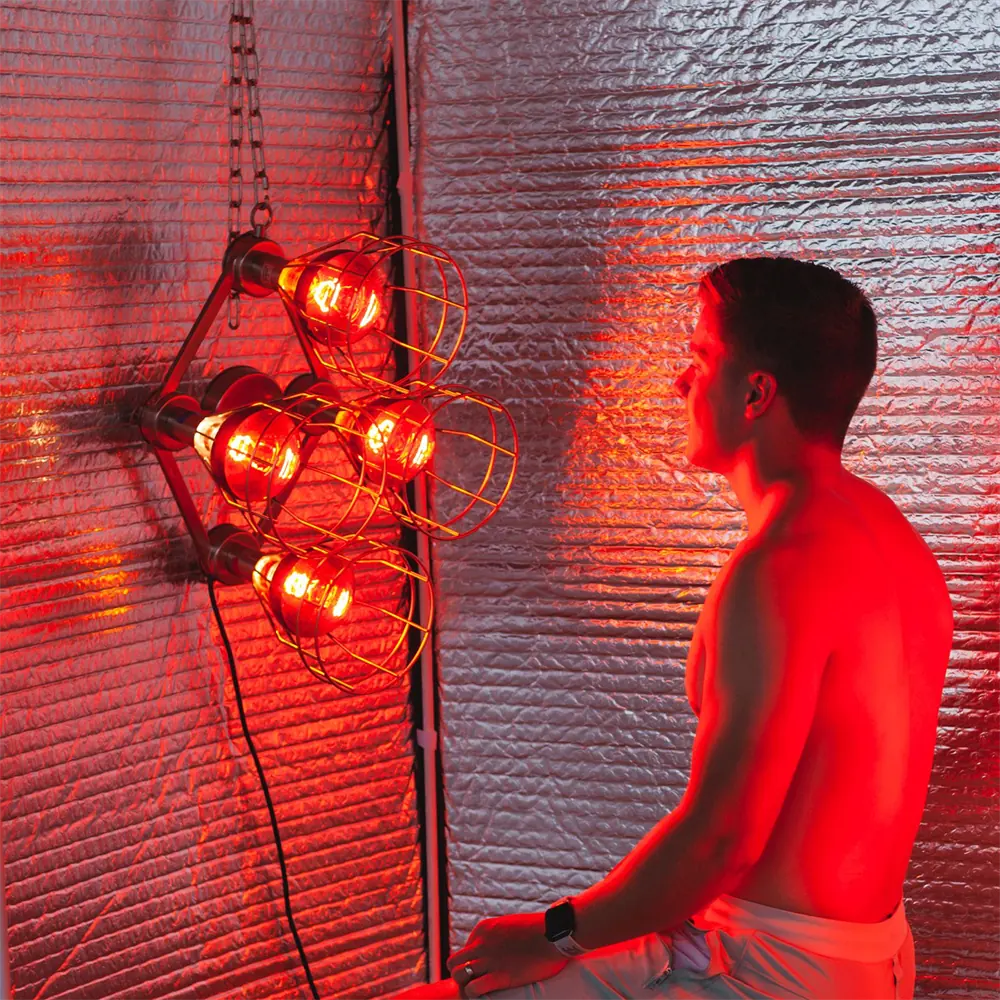
Glowing near infrared sauna bulbs delivering radiant heat

The variables that set your dose

SpectrumContinuous from ~550 nm
Single lamp~140–145°F (4 bulbs)
Double lampup to ~185°F (8 bulbs)
Seating~18–30 in from bulbs
The useful lens

Wavelength is only one part of the dose

Both incandescent near-infrared systems and far-infrared cabins warm the body and produce sweating — they simply do it in different ways. Wavelength is one variable among many. The complete environment is shaped by the spectrum the bulbs or panels produce, the radiant intensity at your position, your distance from the source, the number and arrangement of emitters, direct versus reflected radiation, enclosure insulation, wall reflectivity and emissivity, ventilation, interior air temperature, session length, and your own physiological response.

That is why it helps to think in terms of two overlapping doses rather than a single label: an optical dose (which wavelengths reach your skin, at what intensity, for how long) and a thermal dose (how much heat stress your body accumulates over the session). An incandescent sauna delivers both at once, and the enclosure design has a large say in each.

What the bulbs emit

The incandescent spectrum begins around 550 nm

Sauna Fix® uses incandescent heat-lamp bulbs with a broad, continuous spectrum beginning around 550 nanometers. Unlike an LED that emits one or two narrow bands, a heated tungsten filament emits many wavelengths simultaneously — visible amber and red light through near, mid, and longer infrared. The boundaries below are useful labels, not rigid biological dividing lines.

Spectral region Approximate wavelength
Amber and orange light 550–620 nm
Visible red light 620–700 nm
Near infrared 700–1,400 nm
Mid infrared 1,400–3,000 nm
Longer infrared Above 3,000 nm

Red light (roughly 620–700 nm) interacts mainly with skin and superficial tissue, while near infrared generally travels farther before being absorbed — though penetration depends on wavelength, tissue, pigmentation, scattering, and dose. Inside the sauna these wavelengths arrive together with substantial heat, so the experience differs from a low-heat LED light session.

Light on the cell

Near infrared, mitochondria, and ATP

Adenosine triphosphate (ATP) is the chemical energy cells use for everyday work — muscle contraction, nerve activity, transport, repair. One frequently studied photobiomodulation (PBM) pathway involves cytochrome c oxidase, an enzyme in the mitochondrial electron-transport chain. Red and near-infrared light may influence cytochrome c oxidase activity, nitric-oxide signaling, mitochondrial membrane potential, transient reactive-oxygen signaling, and downstream gene expression — and the response is strongly dose-dependent. A very low dose may do little; a moderate dose may support a useful response; too high a dose can produce less benefit or added stress.

An honest boundary: most PBM evidence comes from LEDs or lasers delivering selected wavelengths at measured doses — not from whole-body incandescent saunas, which deliver a broad spectrum together with strong heat. The cellular light response and the whole-body heat response happen in the same session, but they are different processes, and it is not established that whole-body sauna exposure reproduces the effects of a targeted PBM device. Note too that the body warms from absorbed radiation and the hot enclosure — not from a meaningful rise in ATP-generated internal heat.
Intensity vs. position

Why distance from the bulbs matters

Radiant intensity drops quickly as distance from the source increases. The bulb manufacturer supplied the following broadband irradiance measurements — total radiant output across many visible and infrared wavelengths, which includes heat, not a therapeutic-wavelength dose:

Distance from bulb Measured broadband irradiance
4 in / 10 cm 1,431 mW/cm²
8 in / 20 cm 670.74 mW/cm²
12 in / 30 cm 268.14 mW/cm²
16 in / 40 cm 101.35 mW/cm²

Sauna Fix® users normally sit about 18–30 inches from the bulb surfaces — considerably farther than those measurement points. Using an inverse-distance estimate from the manufacturer’s figures, direct broadband irradiance at common seating distances is roughly 80 mW/cm² at 18 inches, 45 mW/cm² at 24 inches, and 28 mW/cm² at 30 inches. These are estimates that illustrate how fast intensity falls; actual exposure also depends on the four-bulb arrangement, reflector shape, fixture angle, your height and rotation, the measuring instrument, and reflected energy from the enclosure. The direct beam is strongest on the lamp-facing side; the reflective interior adds a lower-intensity field from other directions.

Design does the work

The enclosure is part of the sauna system

An enclosure does more than provide privacy — it determines what happens to energy after it leaves the lamps. Radiant energy can reach you directly, reflect from the walls, be absorbed into the wall material, warm the air, or escape through seams and ventilation. So the enclosure shapes radiant distribution, warm-up time, air and mean-radiant temperature, stability, and how much energy is lost. This is why two saunas using four identical bulbs can produce different interior temperatures and different experiences.

How the Sauna Fix® enclosure is rated to handle energy

  • R-15 insulation — slows heat transfer through the walls, helping the enclosure hold a higher interior temperature and lose less heat to the room.
  • Low emissivity (~0.03–0.04) — the interior surface is rated to exchange relatively little radiant heat with its surroundings.
  • Reflectivity up to 0.97 — the lining is rated to reflect up to 97% of incident radiant energy back into the occupied space rather than absorbing it into the wall.

Ratings apply under the manufacturer’s stated test conditions and vary by wavelength and method.

Reflection preserves wavelength: a reflected near-infrared photon stays near infrared, and a reflected red photon stays red. Energy absorbed into a wall instead becomes heat in that material, which is later released — usually as longer-wave thermal radiation — and some of it moves outward through the wall. A reflective, low-emissivity lining therefore favors redirection over absorption, keeping more of the original lamp radiation available inside the enclosure and carrying less of it out through the walls. The lining does not create energy; it manages the energy the bulbs already produce, giving radiation more chances to reach you, the seat, and other surfaces.

The core idea

What “thermal dose” really means

Direct infrared can warm your body before the air gets hot, but air temperature still changes how your body handles that heat: as the enclosure warms, you lose less heat to the surroundings, skin temperature rises, sweating increases, and the cardiovascular response grows. So a person in a 115°F enclosure and a person in a 185°F enclosure experience different total heat loads even with the same bulbs. Thermal dose is that accumulated heat stress over time — and it depends on direct and reflected irradiance, air and surface temperature, humidity, session length, distance, body position, exposed area, and your own response.

Optical dose

  • Which wavelengths reach you
  • Direct and reflected irradiance
  • Distance from the source
  • Exposure time

Thermal dose

  • Air and mean-radiant temperature
  • Humidity and session length
  • Skin and core-temperature response
  • Heart rate and sweat loss

Three 20-minute sessions at 115°F, 145°F, and 185°F are not equivalent: the hotter environment reduces your ability to shed heat, usually producing faster sweating and a stronger cardiovascular response. Sauna Fix® is designed to provide both a broad optical spectrum and an adjustable, substantial thermal stimulus — the single-lamp system at ~140–145°F is an intermediate environment, while the double-lamp system reaching ~185°F overlaps the range associated with traditional high-temperature sauna use.

Skin & safety

Infrared and your skin

Infrared is not ultraviolet. UV radiation is strongly associated with sunburn, DNA damage, skin aging, and skin cancer; incandescent sauna bulbs are designed to produce visible and infrared light rather than UV. A modern dermatology review of infrared and skin describes encouraging applications in wound healing, skin rejuvenation, and hair restoration alongside reports of thermal burns and photoaging-related changes — and notes that some adverse effects appear tied to the heat generated during excessive exposure rather than infrared acting on its own. As with the cellular effects, outcome depends on dose.

Manage intensity, heat, and time

The most immediate concern around any powerful heat lamp is overheating. Excessive proximity or duration can cause redness, persistent irritation, or thermal burns. Keep exposure sensible by:

  • staying within the recommended ~18–30 inch distance;
  • rotating periodically and using fewer lamps while adapting;
  • shortening the session — especially with the hotter double-lamp setup;
  • leaving the sauna once the heat becomes uncomfortable.

If you are pregnant, have unstable cardiovascular conditions, faint easily, have impaired heat sensation, or take medications affecting hydration or blood pressure, seek individualized medical guidance before high-temperature sauna use.

Which to choose

How this compares to other saunas

This page is about how the energy reaches you. If you’re deciding which sauna to choose, two companion guides go head-to-head so this one doesn’t have to:

Near vs. Far Infrared

How incandescent near-infrared and far-infrared panel saunas differ in spectrum, sensation, and temperature — and which suits which goal.

Read the comparison

Sauna Fix® vs SaunaSpace

Two incandescent systems, two enclosure strategies: an insulated, reflective shell versus a breathable canvas at moderate air temperatures.

See the head-to-head

The Complete NIR Guide

Start-to-finish on what near-infrared saunas are, how they work, and how to use them.

Read the guide
Evidence

Is this a “full spectrum” infrared sauna?

“Full spectrum” is one of the loosest terms in the sauna market, so here is the honest version. An incandescent sauna lamp genuinely emits a broad, continuous spectrum — visible red, near infrared, and mid-into-far infrared warmth — because that is the physics of a glowing filament, and our published bulb testing shows exactly where that output begins (around 550 nm) and how it distributes. What we will not do is stretch “full spectrum” into a medical promise or an exact-percentages marketing chart no measurement supports. If a brand claims full spectrum, ask for the measured curve — ours is on the testing page.

What the research says

Citations for the mechanism and physiology on this page. Where the evidence is mechanistic, uses targeted light devices, or is observational, that is stated plainly.

PBM mechanism

How red and near-infrared light may act on cells

A foundational review of photobiomodulation mechanisms describes the leading pathways — cytochrome c oxidase, nitric-oxide dissociation, mitochondrial membrane potential, ATP production, reactive-oxygen signaling, and downstream gene transcription.

Read: Hamblin, 2017
The chromophore

Cytochrome c oxidase and nitric oxide

A focused review critically evaluates the evidence for cytochrome c oxidase as the primary light-absorbing chromophore in photobiomodulation and discusses nitric oxide as an important mechanistic pathway.

Read: Photobiomodulation, Photomedicine & Laser Surgery, 2020
Heat physiology

How the body responds to whole-body heat

A comprehensive review of human cardiovascular responses to heat stress describes rising skin blood flow, heart rate, and cardiac output as the body works to shed heat — the thermal side of the sauna dose.

Read: Crandall & González-Alonso, 2010
Longevity signals

Frequent sauna bathing and cardiovascular outcomes

The landmark Finnish cohort of 2,315 men found higher sauna frequency associated with lower sudden cardiac death and all-cause mortality over long follow-up. These are observational associations, not a test of any consumer product.

Read: Laukkanen et al., 2015
Infrared & skin

Infrared in dermatology: benefits and limits

A modern dermatology review of infrared radiation and skin covers wound healing, rejuvenation, burns, and photoaging, and notes that adverse effects are often tied to heat during excessive exposure rather than infrared alone.

Read: Infrared Radiation in Dermatology, 2023

How to read this evidence: the photobiomodulation pathways are well described mechanistically but studied mainly with LEDs and lasers at controlled doses — a whole-body incandescent sauna delivers light and substantial heat together and is not equivalent to a targeted PBM device. The heat physiology is well established, and the Finnish longevity findings are observational. The practical point stands: your result is set by the whole dose — spectrum, intensity, distance, and how the enclosure manages energy — not by the near-versus-far label.

FAQ

My experience

I came to sauna design from nuclear-plant quality assurance, where nothing counts until it is measured. That habit shaped every choice on this page: I did not want to market a wavelength story — I wanted measured lamp output, known distances, and an enclosure that turns radiant energy into a predictable session. When I finally saw the bulb test data mapped against how the tent concentrates that output, the design stopped being a claim and became a dose I could stand behind.

Light, heat, and dose questions

Do Sauna Fix® bulbs produce red light?

Yes. The incandescent spectrum begins around 550 nm and includes amber, orange, and visible red light along with near, mid, and longer infrared wavelengths, all emitted together.

Is incandescent red light the same as an LED red-light panel?

No. LED panels usually emit one or a few narrow wavelength bands with little heat, while an incandescent bulb produces a continuous spectrum plus substantial radiant warmth. The experiences are not equivalent.

Is near infrared associated with ATP?

Red and near-infrared research has reported effects involving mitochondrial signaling and ATP-related activity under controlled conditions. Most of that work uses LEDs or lasers at measured doses rather than a whole-body sauna, which delivers light together with substantial heat.

Does ATP production heat the body?

No. Sauna warming comes from absorbed radiation and the hot enclosure, not from a meaningful increase in heat generated by ATP activity. Mitochondrial signaling and whole-body heating are related parts of the session but different processes.

Why does distance from the bulbs matter?

Radiant intensity falls rapidly as you move away (roughly the inverse-square relationship), so a few inches farther meaningfully lowers direct exposure. Typical seating is about 18–30 inches from the bulb surfaces.

What does R-15 insulation do?

R-value measures resistance to heat moving through an assembly. R-15 slows heat transfer through the enclosure walls, helping maintain a higher interior temperature and reducing heat loss to the room.

What do low emissivity and 0.97 reflectivity mean?

The interior is rated to emit relatively little radiant heat (about 0.03–0.04 emissivity) and to reflect up to 97% of incident radiant energy back into the enclosure under the applicable test conditions, rather than absorbing it into the walls.

Why can two four-bulb saunas reach different temperatures?

Temperature depends on far more than bulb count: insulation, wall reflectivity and emissivity, enclosure size, ventilation, seam construction, fixture geometry, room temperature, and where the thermometer sits all affect heat accumulation.

Is hotter always better?

A hotter enclosure is a stronger thermal dose, but it also places greater demand on hydration and heat tolerance. The best setting is the one you can use safely and consistently.

Can infrared harm the skin?

Excessive heat or very close exposure can irritate or burn skin. Used at an appropriate dose and distance, infrared research also includes beneficial applications such as wound healing and skin rejuvenation. Keep to the recommended 18–30 inch distance and end the session before discomfort.

Explore Sauna Fix® Saunas Near vs. Far Infrared

Educational and safety notice: This page provides general information and is not medical advice. Sauna use creates a meaningful cardiovascular and thermal load. Follow the product instructions, keep the recommended lamp distance, stay hydrated, and leave the sauna if you feel dizziness, nausea, weakness, chest discomfort, confusion, or difficulty breathing.

Keep Exploring

Related guides

Complete NIR Sauna Guide

Read the guide

Near vs. Far Infrared

Read the guide

Sauna Fix® vs SaunaSpace

Read the guide

Near Infrared Sauna Lamps

Read the guide

Sauna Resource Center

Read the guide
  • Search Products
  • My Account
  • Track Orders
  • Shopping Bag
Powered by Lightspeed
Display prices in:USD
Skip to main content
Creatrix Solutions
Saunas
Exercise
Air Purifiers
Skin Care
Salt
Ozone
Enema Kits
Contact
About
Other
Location
Menu

creatrixsolutions

Terms of UsePrivacy PolicyShipping & Payment InfoReturn PolicyReport Abuse
Powered by Lightspeed